
Beyond the Hype: How AI is Actually Winning Personal Injury Cases in 2026
For decades, the lifeblood of a personal injury case was paper. Attorneys, paralegals, and legal assistants spent thousands of hours manually reviewing medical records, cross-referencing treatment dates, and painstakingly drafting chronologies to prove liability and damages. It was a process defined by human diligence, but also by human error, fatigue, and frustratingly slow timelines.
As we navigate 2026, the narrative has shifted. The legal industry has moved past the initial “AI hype” phase—that period where every tech provider promised the world without delivering substance. We have entered the era of practical utility. Today, AI in personal injury cases is no longer a futuristic concept; it is the engine powering a new standard of efficiency, accuracy, and advocacy.
The “Paperwork Bottleneck”: Why Traditional Methods Failed Victims
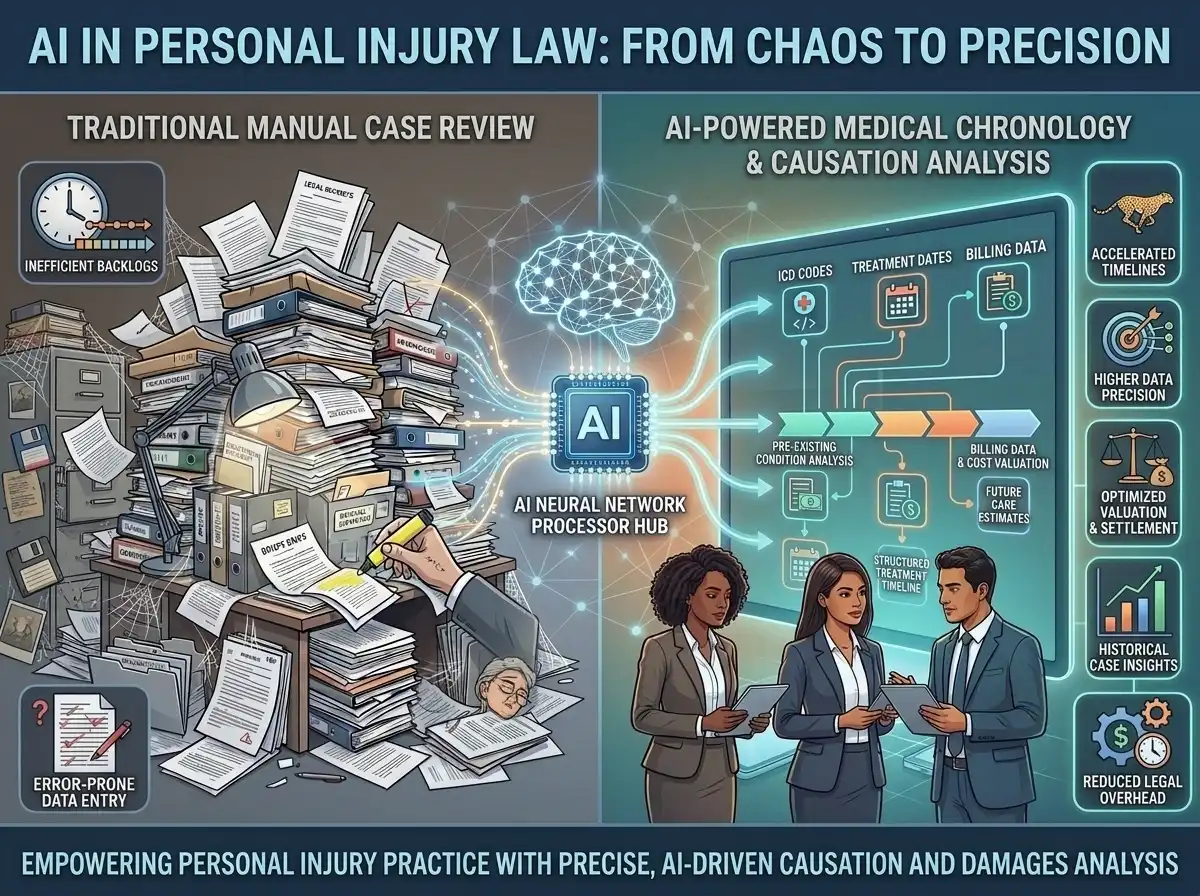
To understand why AI is a game-changer, we must look at the problem it solves. In a standard multi-vehicle accident or complex premises liability claim, a victim may have records from three different hospitals, two physical therapists, and a primary care physician. We are talking about 2,000 to 5,000 pages of unstructured data.
In the traditional model, this mountain of paper created a massive bottleneck. Attorneys were forced to spend weeks or months just “digesting” the evidence before they could even begin the actual negotiation or litigation strategy. This delay didn’t just frustrate the legal team—it directly harmed the client. Every day spent waiting for a medical summary was a day the client spent in financial limbo, waiting for their settlement.
The AI Shift: Turning Data into a “Case Spine”
 In 2026, top-tier personal injury firms have integrated specialized AI legal tools that treat these records not as “paper,” but as “data.” These systems perform tasks that once consumed hundreds of billable hours in minutes:
- Automated Medical Chronology: AI instantly identifies treatment dates, providers, and procedures, organizing them into a seamless timeline that establishes a clear “narrative of injury.”
- Data Extraction: Systems can pull specific ICD-10 diagnostic codes, billing amounts, and medication history, ensuring that no document is overlooked.
- Pattern Recognition: Advanced algorithms can flag discrepancies in medical billing or missing treatment notes that might undermine a claim, allowing the attorney to address these issues proactively.
This does not replace the attorney. Instead, it builds a “case spine.” With the facts organized and the timeline crystallized by AI, the legal team can focus on their actual job: crafting the human argument, negotiating with insurance adjusters, and ensuring the client’s story is heard.
Why This Matters to the Client: Speed and Fairness
For the average person who has been injured in an accident, the legal process is intimidating and opaque. By utilizing AI, firms aren’t just working “faster”—they are working with greater precision. When a demand letter is supported by an AI-verified, comprehensive medical chronology, it is much harder for insurance companies to lowball or deny claims based on “incomplete records.”
Furthermore, this technology allows for more transparency. Clients want to know how their case is progressing. When a firm can generate an updated, accurate status of a client’s medical progress in seconds, it builds trust and reduces the anxiety that naturally accompanies a long legal battle.
Addressing the Ethics and Privacy Question
Of course, the use of AI in a legal setting brings up critical questions regarding data security and ethics. In 2026, the firms “winning” are those that prioritize privacy-first AI implementations. Ethical firms utilize closed-loop, secure AI environments where sensitive client health data is never used to train public models. They recognize that while technology is a tool, the client’s right to confidentiality is absolute.
The goal of AI in this space is not to automate the “human” out of the law; it is to remove the administrative drudgery so that the human element can take center stage.
The Future of Personal Injury Advocacy
 As we look at the remainder of 2026 and beyond, the competitive advantage in personal injury law is clearly shifting toward those who adopt high-tech efficiency. Cases are becoming more complex, and insurance company data analytics are becoming more aggressive. To win in this environment, victims need representation that is as technologically sophisticated as it is personally committed.
AI is not replacing the “Advocator” in Accident Advocator—it is empowering them. By leveraging the power of machine learning, firms can ensure that medical histories are perfectly presented, liability is crystal clear, and the path to justice is as short and unobstructed as possible.
Are you dealing with an injury and need a team that uses every modern tool to secure your future? Contact the experts at Accident Advocator to see how we combine cutting-edge technology with the human dedication you deserve.