
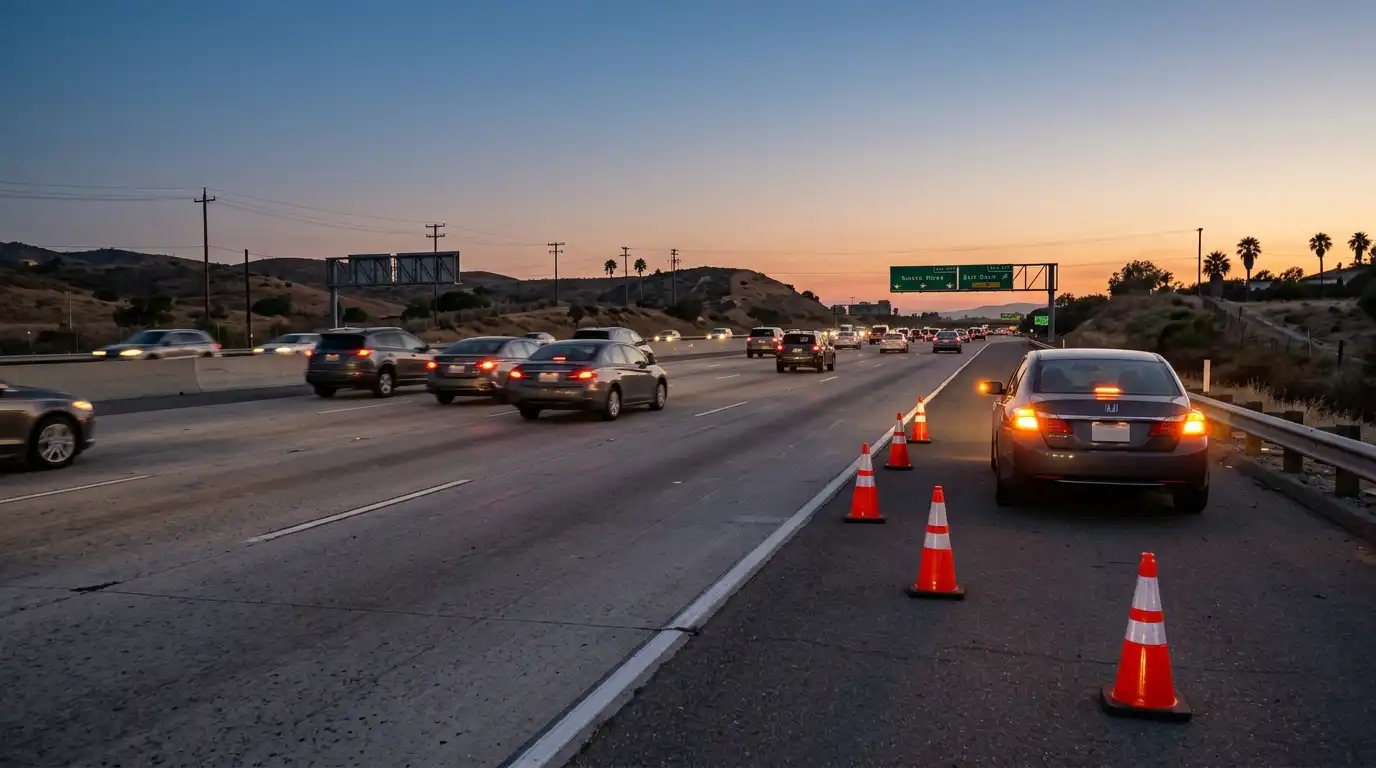
The updated law mandates that drivers slow down or change lanes when approaching any stationary vehicle displaying hazard lights, warning flares, or cones along California roads. Understanding AB 390 is crucial not only for avoiding costly traffic tickets, but also for understanding civil liability and fault determination after a roadside accident.
Understanding the Expansion: What Changed Under AB 390?
 Prior to the passage of AB 390, California drivers were legally obligated to move over or slow down primarily when approaching marked emergency vehicles—such as police cars, fire engines, ambulances—and tow trucks displaying flashing amber lights.
Under the expanded provisions of AB 390, California law now protects all stranded motorists and roadside workers alike. According to official updates from the California DMV, drivers approaching any stopped vehicle showing hazard lights, warning flares, or traffic cones must take immediate corrective action.
Key Drivers & Vehicles Covered:
- Disabled Passenger Cars: Ordinary civilian commuters pulled over due to flat tires, engine failures, or medical emergencies displaying hazard lights.
- Utility & Delivery Vehicles: Municipal, delivery, or construction vehicles operating alongside roadways.
- Emergency & Service Crews: Traditional first responder units, California Highway Patrol (CHP), tow trucks, and highway maintenance crews.
What Are Drivers Legally Required to Do?
When traveling in the same direction and approaching a stationary vehicle on the shoulder or side of the road, AB 390 outlines two clear options based on traffic conditions:
- Change Lanes When Safe: Move out of the lane immediately adjacent to the stopped vehicle into an available lane further away. You should only perform a lane change if traffic and road conditions permit doing so safely.
- Slow Down to a Safe Speed: If changing lanes is unsafe or impossible due to heavy traffic, weather, or road obstacles, you must significantly reduce your speed and proceed past the stationary vehicle with extreme caution.
For additional safety protocols on highway driving and emergency procedures, review guidelines published by Caltrans Move Over Safety.
Penalties for Violating AB 390 in California
Failing to obey California VC § 21809 is classified as a traffic infraction. Penalties associated with a violation include:
- Base fines and state surcharge assessments.
- Points added to your California driver’s license record.
- Potential increases in personal auto insurance premiums.
Beyond traffic citations, violating this statutory duty carries far greater financial and legal risks if your failure to move over leads to a collision.
How AB 390 Impacts Personal Injury & Accident Claims
Roadside accidents along California freeways often result in catastrophic injuries or severe property damage. When a motorist strikes a vehicle stopped on the shoulder, AB 390 plays a vital role in establishing fault.
1. Negligence Per Se
In California personal injury law, if a driver violates a safety statute designed to prevent specific injuries—such as AB 390—that statutory violation can serve as strong evidence of negligence per se. If a driver fails to slow down or clear the lane and crashes into a stopped car displaying hazard lights, the driver is frequently presumed negligent.
2. Comparative Fault Considerations
California operates under a pure comparative fault doctrine. In cases where a disabled vehicle was partially obstructing a traffic lane or lacked illuminated hazard lights, fault may be split between parties. However, passing drivers who disregard clear hazard indicators usually bear the primary responsibility for resulting damages.
Essential Safety Tips for California Roadside Emergencies
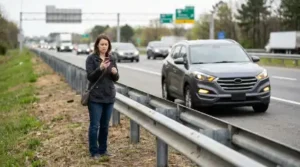 If your vehicle breaks down on a busy California highway or freeway, take these steps to maximize your safety:
- Turn On Hazard Flashing Lights Immediately: Activating your hazards triggers the statutory duty under AB 390 for passing traffic.
- Pull Off Completely: Try to reach a safe exit or pull as far onto the right shoulder as possible.
- Deploy Roadside Indicators: Place safety cones, reflective triangles, or warning flares behind your vehicle if safe to do so.
- Stay Protected: Remain inside your vehicle with your seatbelt fastened, or exit and stand behind protective guardrails well away from oncoming lanes.
Conclusion
The expansion of California’s Move Over Law under AB 390 reinforces a crucial safety principle: giving extra space saves lives. Whether passing a highway patrol unit or an ordinary driver with a flat tire, staying alert, changing lanes, and reducing speed protects everyone on the road. If you or a loved one are impacted by a roadside crash, understanding these updated statutory duties is key to protecting your safety and legal rights.